
- June 23, 2026
- (0)
- Maid service
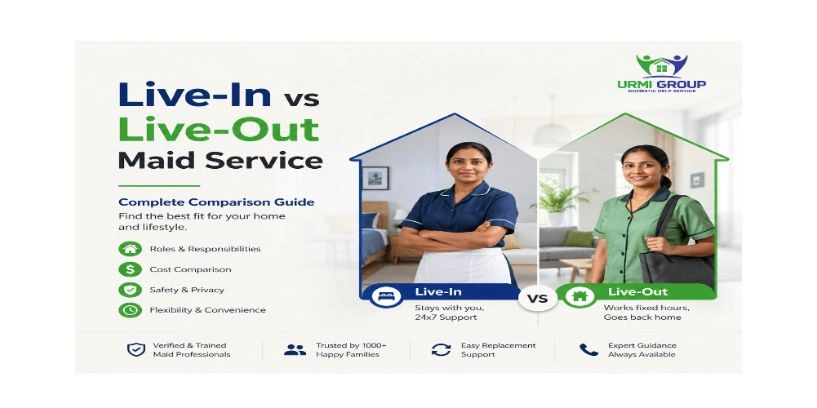
A lady maid that lives at your place and is representative for set hours with consented rest timings throughout the day. She clocked out as a live-out maid and went home. In Delhi NCR, the live-in price from Rs. 15,000–23,000 in cities and zones; live-out (part-time/full-time) must bring home Rs. 7,000–17,500 per month. The choice to make is less about cost and more about your household’s true requirement for round-the-clock coverage.
Most families default to live-in because it sounds all encompassing, then realize once they get the accommodation, privacy, and management burden were not as expected. Some default to live-out, for privacy purposes, end up over-stretched in emergency situations where there is no backup. The purpose of this guide is to compare both fairly so you make your decision based on actual demand and not assumptions.
Search professional senior citizen care services in Delhi NCR near you.
Short Answer: Use live-in for newborns, elderly parents needing someone around the day, or if you travel a lot. Select live-out if privacy is essential, your home smaller or requirements are limited to fixing hours per.
Contents
Live-In vs Live-Out: Full Comparison
| Factor | Live-In | Live-Out |
|---|---|---|
| Accommodation Needed | Yes — separate room required | No accommodation needed |
| Monthly Cost (Delhi NCR) | ₹15,000–23,000 | ₹7,000–17,500 |
| Availability | Available throughout the day with agreed rest hours | Fixed daily working shift |
| Privacy Impact | Higher — maid stays at home overnight | Lower — leaves after shift |
| Best For | Newborn care, elderly care, frequent travellers | Regular households and privacy-focused families |
| Notice Period | Typically 4 weeks | Usually 2–4 weeks |
| Management Overhead | Higher — accommodation, meals, and boundaries to manage | Lower — fixed hours and simpler management |

Five Questions to Decide Which One You Actually Need
- Do you need someone present overnight? If yes — newborn care, elderly safety, frequent night-time needs — live-in is the only arrangement that covers this.
- Do you have a separate room to offer? Live-in requires accommodation. Without a spare room, live-in is not a realistic option regardless of need.
- How important is privacy to your household? A live-in arrangement means a non-family member is present in your home around the clock. Some families adapt easily; others find this uncomfortable long-term.
- What is your actual daily task load? If tasks fit comfortably into a defined daily window, live-out is more cost-efficient and simpler to manage.
- Do you travel frequently or have irregular hours? Live-in provides continuity when your own schedule is unpredictable. Live-out requires more advance planning around your own availability.
Decide With Confidence — Compare Options for Your Household
Urmi Group | Live-in and live-out placements | Police-verified | urmigroup.in.
For sector-specific rates
What Live-In Actually Involves Day to Day
Even live-in maids aren’t gonna be working 24 hours a day. Rest hours overnight are also agreed in writing — active working hours are usually between 6 and 8. Room of her own, household provides food and a peace day once a week. While it requires more advanced planning than a live-out, it is something that shifts will never provide continuity.
Families taking the live-in plunge for the first time are most likely unprepared to have open discussions about house rules, separation between public and personal space, household routines and everything else before she moves in. This is outlined in the written placement agreement, not subject to assumption.
Checklist: Before Choosing Live-In or Live-Out
- Confirm whether you have a genuinely usable separate room for live-in
- Calculate your actual daily task hours honestly — do not overestimate
- Discuss privacy comfort with everyone in the household, not just the primary decision-maker
- Get the active hours, rest hours, and rest day documented in writing for live-in
- Budget the full live-in cost including meals, not just the headline salary
- Reassess in 3 months — needs often change after a newborn’s first weeks or after an elderly parent settles in
For sector-specific rates
A Family That Switched From Live-Out to Live-In — and Why
The Kapoor family in Gurgaon had a live-out full-time maid for two years — reliable, but gone by 6 PM each evening. When their second child was born in early 2025, the evening and night workload became unmanageable. They switched to a live-in arrangement through Urmi Group within a week of the delivery.

The transition required setting up a guest room as her accommodation and a clearer conversation about household boundaries than they had needed with the live-out arrangement. Mrs. Kapoor’s reflection six months in: ‘We assumed live-in would feel intrusive. It felt structured instead, because we put the rules in writing from day one.’
Frequently Asked Questions
With clear, documented boundaries — designated room, agreed hours, house rules discussed upfront — most families adjust comfortably. The discomfort families report usually traces back to skipping this upfront conversation, not the arrangement itself.
Yes, this is a common transition — particularly after a new baby or when an elderly parent moves in. It requires a new agreement covering accommodation, salary adjustment, and revised duties.
Often comparable, sometimes lower, when you account for the coordination overhead of managing two separate part-time arrangements. Live-in also covers gaps that two shift-based helpers cannot, such as overnight needs.
The notice period — typically 4 weeks — gives both sides time to plan the transition. The accommodation arrangement ends with the placement; this should be clearly stated in the written agreement to avoid confusion at the end of the engagement.
Find the Right Arrangement for Your Household
Live-in and live-out placements | Urmi Group | urmigroup.in

Leave a Reply