
- June 24, 2026
- (0)
- japa maid
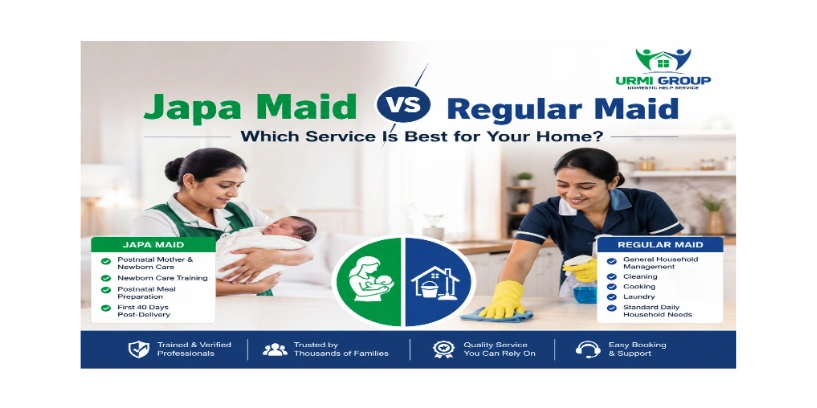
A Japa maid specialises in postnatal mother recovery and newborn care for roughly the first 40 days after delivery. A regular maid handles general household cleaning, cooking, and laundry without specific training in either area. Hiring a regular maid for postnatal needs — or a Japa maid for ongoing household work — both lead to mismatched expectations. This guide explains exactly when you need which.
This is usually confusing because the two roles intersect on basic household responsibilities — both can do simple cooking, both can clean. The concept lies in experiential training: a Japa maid has knowledge on infant hygiene, breastfeeding support, cord care and preparing your traditional postnatal diet. A normal maid does not have this kind of training, unless it was sourced directly for that job.
Short Response: Need postnatal/newborn-specific support during those first 40 days? Hire a Japa maid. Looking for continual more general household assistance after this timeframe
Search professional senior citizen care services in Delhi NCR near you.
Contents
Japa Maid vs Regular Maid: Full Comparison

| Factor | Japa Maid | Regular Maid |
|---|---|---|
| Primary purpose | Postnatal mother & newborn care | General household management |
| Newborn care training | Yes — hygiene, feeding, cord care | Not standard |
| Postnatal meal preparation | Yes — traditional recovery diet | Not specialised |
| Typical engagement length | 40 days (extendable) | Ongoing, indefinite |
| Monthly cost (full-time, Delhi NCR) | Rs. 30,000–40,000 | Rs. 12,000–17,500 |
| General cleaning included | Yes, as secondary duty | Yes, as primary duty |
| Best for | First 40 days post-delivery | Standard daily household needs |
Why the Cost Difference Is So Significant
A Japa maid’s monthly rate runs roughly two-and-a-half times a regular full-time maid’s rate. This reflects the specialised training, the intensity of round-the-clock newborn responsiveness during the engagement, and the shorter, fixed-term nature of the placement — candidates are compensated at a premium for a high-intensity, time-limited role rather than an ongoing one.
This is not a markup without substance. According to WHO guidance on maternal health, the postnatal period carries specific physical recovery and infant care needs that benefit from trained, attentive support — not simply extra pairs of hands.
Five Scenarios That Tell You Which One You Need
- You are due to deliver within the next month. Book a Japa maid now. Availability tightens closer to common delivery windows.
- Your baby is already 2 months old and you need ongoing help. The Japa window has passed. A regular maid, or a regular maid plus a dedicated babysitter, fits better now.
- You need cooking, cleaning, and general support — no newborn in the picture. A regular maid, full-time or part-time, is the right and more affordable fit.
- You are recovering from a C-section and need both newborn and recovery support. A Japa maid with C-section recovery experience specifically — request this at intake.
- Your Japa engagement is ending in two weeks and you will still need household help. Start the regular maid search now, in parallel, so there is no gap when the Japa engagement concludes.
Not Sure Which One You Need? Talk to Our Placement Team
Urmi Group | Japa maid and regular maid placements | urmigroup.in.
Can a Japa Maid Continue as a Regular Maid After 40 Days?
Sometimes, yes. If the family and the Japa maid have a good working relationship and she is willing, the engagement can transition into a standard full-time placement once the postnatal period ends — typically with a salary renegotiation, since the duty scope and intensity change. This is not guaranteed and depends on the individual candidate’s availability and interest in ongoing work, but it is a common and convenient outcome when it happens.
For families exploring this path
Checklist: Choosing Between Japa and Regular Maid
- Confirm your delivery date — book a Japa maid 2–4 weeks ahead for best availability
- Specify C-section or normal delivery if relevant at intake
- Decide whether postnatal cooking is a requirement — not all regular maids are trained for this
- Plan the transition to a regular maid before the Japa engagement ends, not after
- Budget separately — Japa and regular maid rates differ significantly
- If continuing with the same candidate post-40 days, renegotiate salary and scope explicitly
Frequently Asked Questions
Not reliably. A regular maid without postnatal training may handle basic tasks but typically lacks specific training in newborn hygiene, breastfeeding support, and traditional postnatal meal preparation. For the first 40 days, this gap matters.
Less common but not unusual, particularly in larger households where one person handles postnatal and newborn duties while another continues general household management. Most families, however, manage with a Japa maid alone during the 40-day window.
Book a Japa maid 2 to 4 weeks before the expected delivery date for the best candidate availability. A regular maid replacement, if needed after the Japa period, can typically be arranged within 24 to 72 hours when the time comes.
A Japa maid’s specialised training is specific to the newborn and postnatal mother phase, generally the first 40 days. Beyond infancy, a nanny or babysitter is the more appropriate specialised role — different training, different focus.
Book the Right Care for Your Family’s Stage
Japa maid and regular maid placements | Urmi Group | urmigroup.in

Leave a Reply